How to Build a Budget That Survives Real Life
Most budgets fail in week three, not week one. Here is a monthly system built around irregular income, annual bills and the spending you are not going to stop doing.
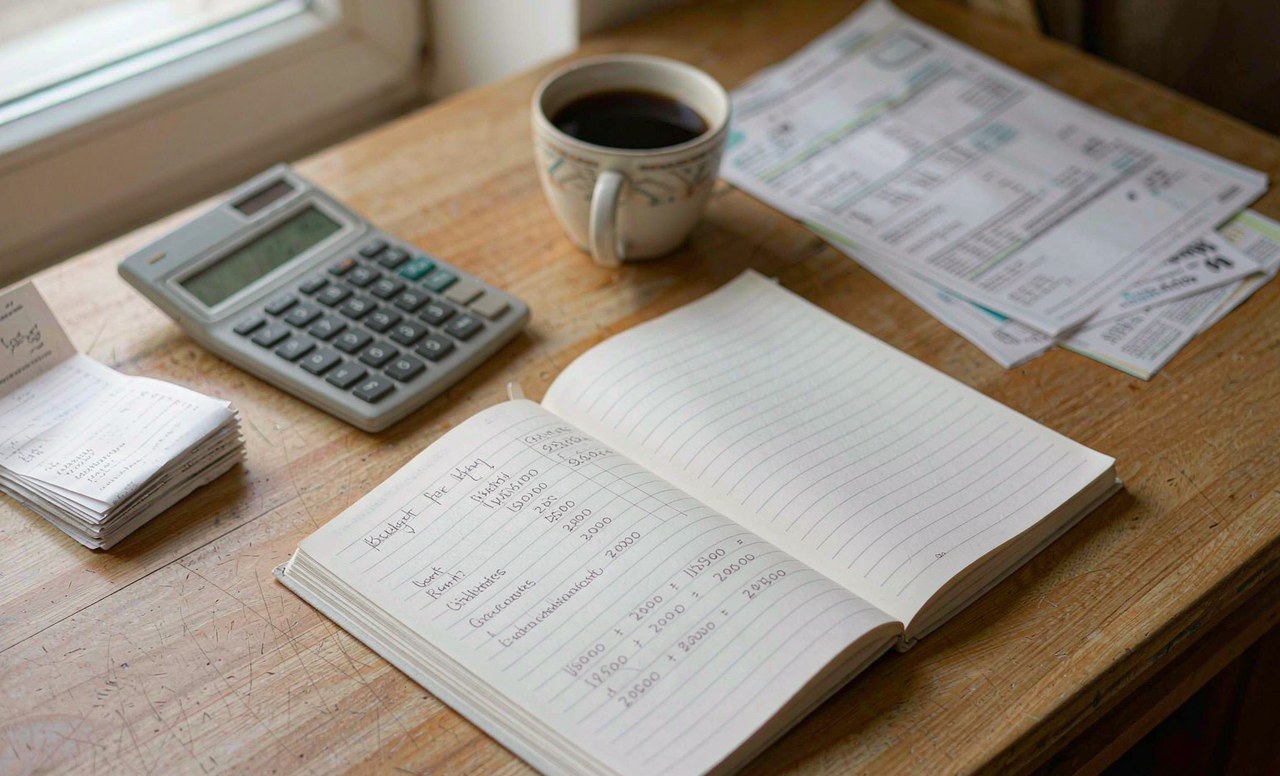
Budgets rarely fail because the maths was wrong. They fail because the plan assumed a life that does not exist — one where income arrives on the same day each month, no annual bill ever lands unexpectedly, and you cheerfully stop buying coffee. Three weeks later the spreadsheet is abandoned and the feeling of having failed is worse than never starting.
The approach below is built the other way around. It starts from the money that actually moves through your account, keeps a fixed allowance for the spending you are not going to give up, and treats annual expenses as a monthly cost rather than a surprise.
Start with three months of real transactions, not a template
Before you categorise anything, export the last three months of transactions from every account you spend from — current account, credit cards, and any payment app with a balance. Three months is the minimum that captures a quarterly bill or an annual renewal. Fewer than that and you will build the budget around a month that happened to be unusually cheap.
Put them in one table with four columns: date, description, amount, and a rough category. Do not aim for precision at this stage. Twenty categories is too many to maintain; twelve is about the most a person will keep up with. A workable starter set:
- Housing — rent or mortgage, property tax, insurance
- Utilities — electricity, gas, water, internet, phone
- Groceries — food eaten at home
- Eating out — restaurants, takeaway, delivery
- Transport — fuel, transit, parking, rideshare
- Insurance — health, auto, life (anything not tied to housing)
- Debt payments — minimums on loans and cards
- Subscriptions — everything recurring, including the ones you forgot
- Health — prescriptions, appointments, dental
- Personal — clothing, haircuts, hobbies
- Children and pets — childcare, supplies, vet
- Savings and sinking funds — see below
The subscriptions line is where most people find money immediately. Recurring charges are designed to be invisible: small enough to ignore individually, large enough to matter added up. When you list them side by side for the first time, the total is usually the single most surprising number in the exercise.
Convert annual costs into a monthly line
Annual bills are what break a monthly budget. Insurance premiums, car registration, professional memberships and annual software renewals all land in a single month and shred whatever plan you had. The fix is a sinking fund: divide the annual amount by twelve and move that smaller amount into a separate savings pot every month.
| Annual expense | Yearly | Monthly set-aside |
|---|---|---|
| Auto insurance | $1,140 | $95.00 |
| Car registration and inspection | $180 | $15.00 |
| Home or renters insurance | $360 | $30.00 |
| Annual software and memberships | $420 | $35.00 |
| Holiday and birthday gifts | $900 | $75.00 |
Those five lines add up to $250 a month, which is a real number to budget for. But compare it with the alternative: a $1,140 insurance premium arriving in one month, funded by a credit card, paid off over four months with interest. The monthly version is not just tidier — it is cheaper.
Where to keep the sinking fund. A separate savings account at the same institution, named for its purpose. It needs to be liquid and slightly inconvenient — liquid so the money is there when the bill lands, inconvenient enough that you are not dipping into it for a night out.
Handle irregular income with a base-plus-surplus rule
Freelancers, commission earners, shift workers and anyone paid weekly face a version of this problem: the budget has to work in a month that is 30% below average. Two rules make that manageable.
The first is to budget from your lowest normal month, not your average. If the worst non-catastrophic month in the last year brought in $3,200, budget against $3,200. Anything above that is surplus. This is conservative on purpose: a budget you can hit every month is worth more than one that works in a good month and collapses in a bad one.
The second is to split every payment the moment it arrives. As soon as money lands in the account, move it into four buckets before you spend any of it:
- Bills — the fixed costs you cannot avoid
- Living — groceries, transport, day-to-day spending
- Buffer — one month of bills, built up and then held
- Everything else — savings, debt overpayment, discretionary
The buffer is the piece that makes irregular income survivable. Once it holds one month of fixed costs, a slow month stops being an emergency and becomes an inconvenience.
The 50/30/20 split, and when to ignore it
The most widely cited budgeting framework splits take-home pay into 50% needs, 30% wants and 20% savings and debt repayment. It is a reasonable starting point and a poor rule to be dogmatic about.
It works well when housing costs are moderate. It becomes unworkable in cities where rent alone eats 45% of take-home pay — a common situation that no amount of budgeting discipline changes. In that case the honest options are to increase income, change housing, or accept a temporary split closer to 65/20/15 while you work on one of the first two.
Use the split as a diagnostic, not a grade. If your needs are at 65% and you are saving nothing, the interesting question is which of those three numbers you can actually move this quarter. Usually it is the income side, because housing is a multi-month project and discretionary spending is already thin.
Give yourself a real allowance
The most common failure mode is a budget with no line for the spending you actually enjoy. It looks virtuous in the spreadsheet and lasts about eleven days. A budget needs a guilt-free category — money you can spend on anything, with no tracking and no justification.
Set it as a fixed weekly or monthly number and hold it firm. The point is not the amount; it is that the rest of the plan gets to stay strict because this part is deliberately loose. People who allow themselves $150 a month of no-questions spending are far more likely to still be budgeting in month nine than people who allow themselves zero.
Review monthly, and only change one thing
Set a recurring 30-minute appointment at the end of each month. Do three things: compare actual spending against the plan by category, note the largest deviation, and change exactly one line for next month.
Changing one thing at a time is what makes the process compound. If you change five categories at once you cannot tell which change worked. If you change one, by month six you have a budget that genuinely fits — built from evidence rather than optimism.
Expect the first three months to be wrong. That is not failure; it is data collection. A budget is a model of your life, and models get better with feedback.
What to do when you blow it
You will overspend in some category. The response matters more than the event. Do not restart from zero, do not declare the month ruined, and do not compensate by cutting something you value to punish yourself.
Instead, find the offset within the same month or the next one. Overspent on eating out by $80? Take it from the personal category or from this month's surplus allocation, and log it. The budget is a running system, not a series of independent attempts. Carrying a small deficit forward is normal and much healthier than the cycle of strict months followed by abandonments.
The measure of a working budget is not that you never deviate. It is that you notice, correct and continue — and that after six months the numbers in the plan look more like your actual life than they did at the start.

